

Medico legal work sits at the intersection of clinical medicine and the legal system, encompassing the preparation of expert witness reports, causation opinions, independent medical examinations, personal injury assessments, and the clinical review of legal cases that require physician expertise to interpret. Artificial intelligence is now actively changing how medico legal work is researched, documented, and reviewed, with tools capable of processing large volumes of medical records, identifying relevant clinical literature, and flagging inconsistencies in clinical timelines faster than any manual review process could achieve. For physicians engaged in or considering medico legal work, understanding how AI is entering this space, what it can legitimately assist with, and where its limitations create serious risk is no longer optional. It is a professional obligation.
If you are a physician who provides expert witness opinions, a lawyer working with medical consultants on litigation files, or a healthcare professional considering entry into medico legal consulting, you are navigating an environment that is changing faster than most professional guidelines have been updated to address. Here are the questions that come up most often on this topic: Can AI write expert witness reports on behalf of a physician? What are the legal risks of using AI tools in medico legal work? How is AI changing the speed and cost of medical record review in legal cases? Are courts in Canada beginning to address AI-generated medical evidence? What responsibilities does a physician retain when using AI assistance in medico legal work? This guide addresses each of these questions directly.
What Is Medico Legal Work and Who Performs It

Before examining how AI is changing it, it is worth being clear about what medico legal work actually involves, because it is a broader category than many physicians realize and one that carries specific professional and legal obligations that are distinct from ordinary clinical practice.
Medico legal work includes independent medical examinations commissioned by insurers, employers, or legal counsel to assess a claimant’s injuries, functional capacity, or causal relationship between an event and a medical outcome. It includes expert witness reports prepared for civil litigation, criminal proceedings, regulatory hearings, and workers compensation appeals. It includes causation opinions that address whether a specific incident or exposure caused or contributed to a diagnosed condition. It includes review of medical records and clinical documentation to identify gaps, inconsistencies, or deviations from the standard of care that are relevant to a legal dispute.
Physicians who perform medico legal work do so as independent experts whose opinions are grounded in their clinical expertise, the available evidence, and the specific questions posed to them by instructing counsel or assessment bodies. Unlike treating physicians, whose primary obligation is to their patient, physicians performing medico legal work are obligated to the court or tribunal, not to the party that retained them. This duty of impartiality, known formally as the duty to the court, is the ethical cornerstone of expert witness practice and the feature of medico legal work that makes AI integration particularly complex.
How AI Is Changing Medico Legal Work in Canada
Artificial intelligence is entering medico legal work through several distinct pathways, each with a different risk profile and a different set of professional considerations.
The most straightforward application is in medical record review and organization. Personal injury and medical negligence cases frequently involve thousands of pages of clinical records, imaging reports, specialist letters, and pharmacy dispensing histories spanning years of a claimant’s care. AI tools capable of ingesting, organizing, and summarizing large document sets can dramatically reduce the time required for a physician to identify the records most relevant to the legal question at hand. When used as a document organization and flagging tool, with the physician conducting their own substantive review of the flagged material, this application of AI to medico legal work is largely consistent with existing professional obligations, provided the physician maintains genuine intellectual ownership of the opinion ultimately produced.
Natural language processing tools are also being used to identify relevant clinical literature for the causation and standard of care questions that arise in medico legal work. A physician preparing an expert opinion on whether a specific surgical complication constitutes a deviation from the standard of care can use AI-assisted literature search tools to identify the most current and most relevant clinical evidence, reducing the time spent on manual database searching. Again, the critical issue is whether the physician independently evaluates the identified literature or delegates that evaluation to the AI tool.
The more problematic application, and the one that is generating the greatest professional concern, is the use of generative AI to draft the expert witness report itself. Several high profile cases in the United States and United Kingdom have already surfaced the problem of AI-generated legal documents that contained fabricated case citations, a phenomenon now commonly referred to as AI hallucination. In the context of medico legal work, a physician who signs an expert report that was substantially drafted by a generative AI tool without rigorous verification of every factual and legal claim within it is exposing themselves to serious professional and legal liability, regardless of whether the AI assistance was disclosed.
The Risks of AI in Medico Legal Work That Physicians Must Understand
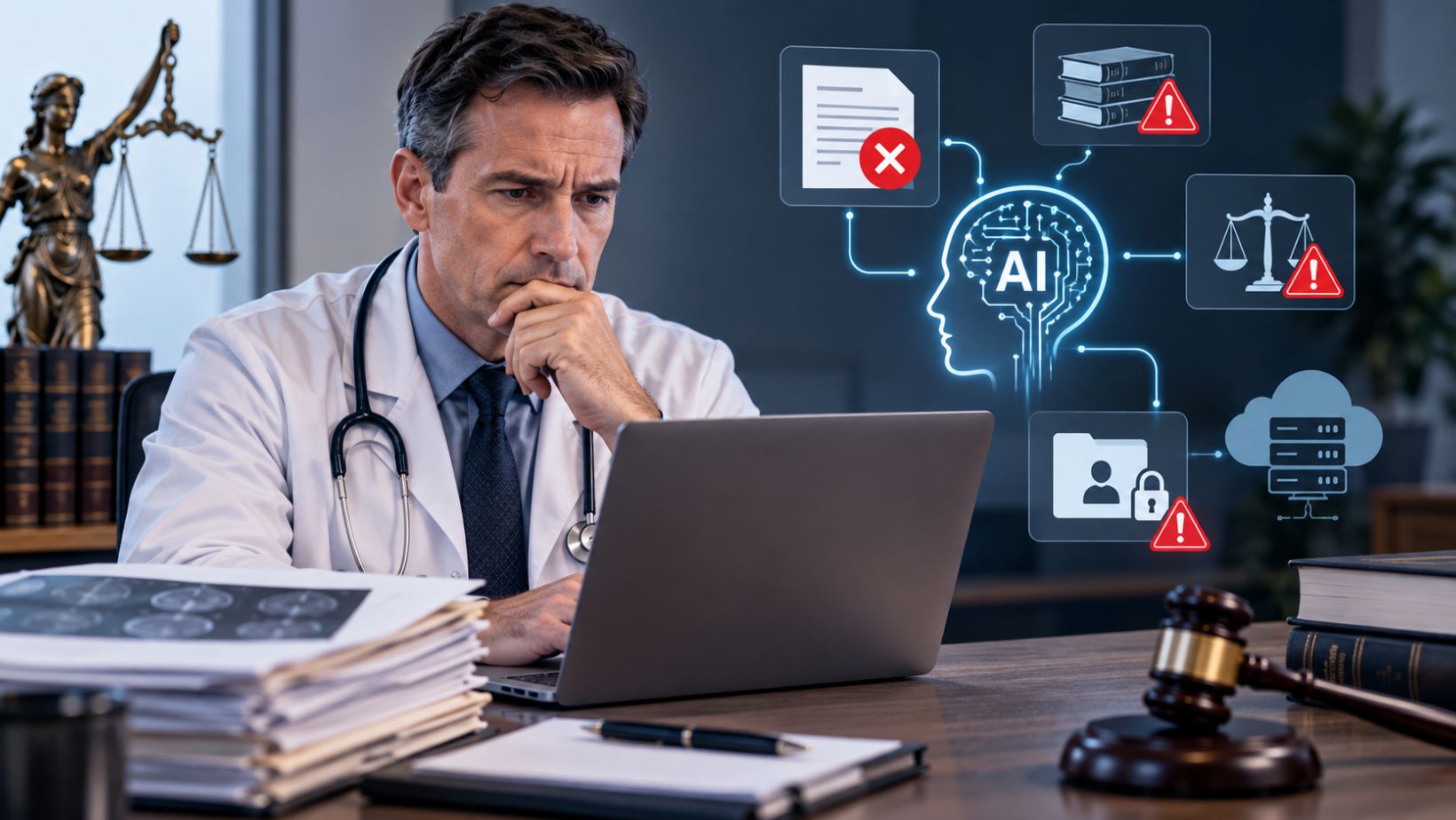
This is the section that matters most for any physician currently using or considering AI assistance in their medico legal work, and it deserves the clearest possible treatment.
The fundamental ethical constraint governing medico legal work is that the expert opinion must be genuinely the physician’s own. The opinion must reflect the physician’s independent clinical judgment, formed after personal review of the relevant materials, and the physician must be able to defend every element of that opinion under cross examination without reliance on AI tools that the opposing counsel and the court may not have access to or visibility of.
AI tools, including the most advanced large language models currently available, have documented tendencies toward generating plausible sounding but factually incorrect medical and legal content. In medico legal work, a fabricated citation to a clinical guideline, an incorrect attribution of a study’s findings, or an inaccurately summarized diagnostic criterion can be identified and exploited by opposing counsel in a way that destroys the credibility of the entire expert opinion, not just the fabricated element. The evidentiary and reputational consequences for a physician who allows AI errors to pass through their review process in a legal proceeding can be severe and lasting.
Disclosure is the second major risk area. Different jurisdictions are beginning to develop expectations, and in some cases requirements, around disclosure of AI assistance in legal documents. The Canadian Bar Association and various provincial law societies are actively developing guidance in this space, and physicians performing medico legal work in Canada should monitor developments closely rather than assuming that current silence on the issue represents permission.
Data privacy is a third risk that is frequently underestimated. Many AI tools process inputs through servers operated by third parties, which raises real questions about whether submitting patient records or case materials to an AI tool constitutes a breach of privacy obligations, including those under the Personal Information Protection and Electronic Documents Act and provincial privacy legislation.
What Responsible AI Integration in Medico Legal Work Looks Like
None of this means that AI has no legitimate place in medico legal work. It means that physicians must approach AI integration with the same rigor they would apply to any tool that influences a professional opinion in a legally consequential context.
Responsible use begins with maintaining genuine intellectual ownership of the opinion. AI can organize, surface, and summarize, but the physician must independently evaluate every element of the analysis and be able to articulate the basis for each conclusion without reference to the AI tool that assisted in preparing it.
Verification of every factual claim is nonnegotiable. Any citation, study reference, clinical guideline quotation, or factual assertion that appears in an AI-assisted document must be independently verified by the physician against the primary source before the document is submitted. This is not optional oversight. It is the minimum standard for professional accountability in medico legal work.
Working within a structured professional support framework, including maintaining relationships with colleagues experienced in medico legal work and staying current with evolving professional guidance from the Canadian Medical Protective Association and relevant specialty bodies, provides the accountability infrastructure that individual AI use alone does not supply.
MDconsultants has addressed the intersection of physician expertise and consulting roles in their published guide on How Pharmaceutical Companies Benefit From Physician Consultants, which covers related themes around how physicians extend their clinical expertise into advisory and evidence facing roles outside of direct patient care.
The Role of a Medical Consultant in Medico Legal Practice Development
Physicians entering or expanding their medico legal work benefit from working with a medical consultant who understands both the clinical and procedural dimensions of expert witness practice. A medical consultant experienced in medico legal contexts can advise on how to structure independent medical examinations, how to approach causation analysis, and how to construct expert reports that are both clinically rigorous and legally defensible.
Healthcare Consulting and the AI Governance Gap in Legal Medicine
Healthcare consulting has an important role to play in addressing the governance gap that currently exists around AI use in medico legal work. A healthcare consultant with experience in digital health, clinical governance, and legal medicine can help organizations and individual practitioners develop clear policies for AI tool use in medico legal contexts, including documentation standards, verification protocols, and disclosure practices that align with emerging professional expectations.
For authoritative guidance on physician obligations in medico legal work in Canada, including expert witness responsibilities, professional liability considerations, and evolving standards of practice, the Canadian Medical Protective Association provides detailed, jurisdiction-specific guidance that every physician performing medico legal work in Canada should be familiar with.
Medical Consultant Networks and Expert Witness Support
A medical consultant network that includes physicians experienced across multiple medico legal practice areas, including personal injury, medical negligence, occupational disease, and workers compensation, can provide practitioners entering this space with the mentorship, peer review support, and professional development connections that individual practice in isolation does not offer. These networks also provide a resource for lawyers and legal teams seeking well-qualified experts across a broad range of clinical specialties.
Final Thoughts
Artificial intelligence will not replace the physician at the center of medico legal work. The duty to the court, the obligation of independent clinical judgment, and the professional accountability that expert witness practice requires are inherently human obligations that no AI tool can assume. What AI will do, and is already doing, is change the pace, scale, and efficiency of the preparatory work that surrounds medico legal work, creating both opportunities for more rigorous analysis and risks for physicians who adopt these tools without understanding their limitations.
The physicians who will navigate this transition most successfully are those who approach AI assistance with the same critical rigor they bring to interpreting a complex clinical result. Useful, potentially powerful, but always subject to independent verification before any professional opinion rests on it.
If you are looking to connect with experienced medical consultants or explore physician-led consulting support for medico legal practice development, MDconsultants offers a trusted network of medical professionals ready to help.

