
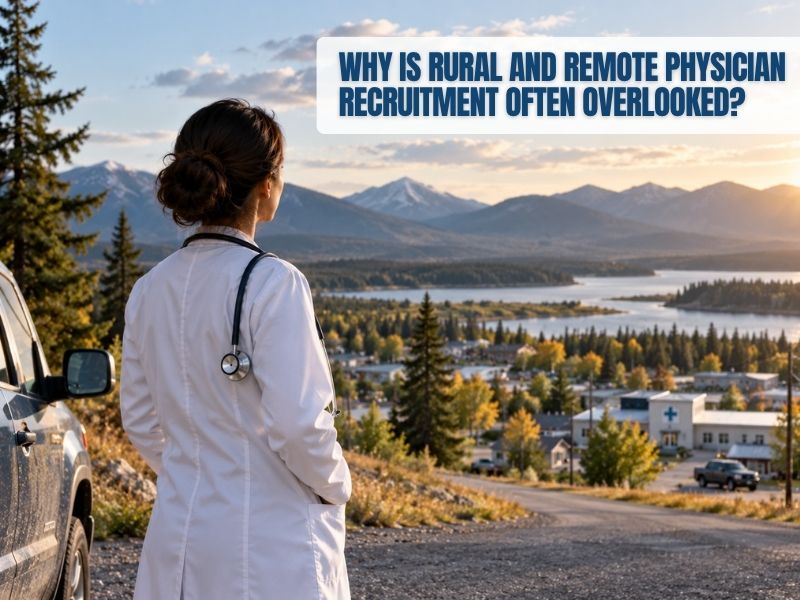
Remote physician recruitment is the process by which healthcare organizations, regional health authorities, and governments work to attract and retain physicians in rural, remote, and northern communities across Canada. It is one of the most persistent and structurally complex challenges in Canadian health system planning, with some communities having gone years or even decades without a stable family physician or specialist, forcing residents to travel hours for care that urban Canadians access within minutes. Effective remote physician recruitment requires more than competitive compensation. It demands a deep understanding of what draws physicians to underserved communities, what makes them stay, and what causes them to leave, often within the first two years of practice.
If you are a regional health authority trying to fill vacancies that have been open for years, a community leader watching your aging population lose access to local care, or a physician wondering whether a rural or remote practice might actually suit your life, this guide is written directly for you. Here are the questions people search most on this topic: Why is remote physician recruitment so much harder than urban hiring? What incentives actually work to attract doctors to rural Canada? How long do physicians typically stay after being recruited to a rural community? What role do medical schools play in rural physician supply? Is remote work changing how remote physician recruitment works? Let us work through each of these honestly.
What Makes Remote Physician Recruitment So Difficult in Canada

To understand remote physician recruitment, you first need to understand the structural forces that created the shortage it is trying to address. Because the physician shortage in rural and remote Canada is not simply a matter of not enough doctors overall. It is a matter of deep distributional inequity in where physicians choose to practice and what the system has done to influence those choices.
The vast majority of Canadian medical school graduates complete their training in major urban academic centres. Teaching hospitals, research opportunities, specialist mentorship, and peer networks are concentrated in cities like Toronto, Vancouver, Montreal, and Calgary. When training ends and practice location decisions are made, the default gravitational pull is toward the environments where physicians trained, where their social networks are established, and where the professional infrastructure they depend on is most developed. Remote physician recruitment is, in large part, a project of overcoming that gravitational pull with compelling alternatives.
The professional challenges of rural and remote practice are real and should be taken seriously rather than minimized. Physicians practicing in rural communities frequently work in relative professional isolation, without immediate access to the specialist colleagues, diagnostic technology, and institutional support that urban physicians rely on as a matter of course. Call schedules in rural settings are often far more demanding than in urban practices because there are fewer physicians to share the burden. The breadth of clinical presentations that a rural physician must manage, including obstetrics, emergency medicine, and complex chronic disease without specialist backup, requires a level of clinical confidence and adaptability that not every physician feels prepared for.
Social and family considerations compound the professional ones. Physicians with partners who have their own careers, children in school systems, or established family and social networks in cities face real and legitimate barriers to remote physician recruitment that financial incentives alone rarely overcome. A signing bonus addresses a short term financial calculation. It does not address whether a physician’s spouse can find meaningful employment in a town of three thousand people.
Why Short Term Recruitment Does Not Solve a Long Term Problem
Here is something that health system planners sometimes learn the hard way: remote physician recruitment that results in a two year stay followed by departure leaves a community in a worse position than a sustained vacancy would have, because each departure disrupts continuity for patients, exhausts the organizational capacity invested in recruitment, and signals to remaining physicians and community members that the situation is not improving.
The data on physician retention in rural and remote settings consistently points to a cluster of factors that predict whether a newly recruited physician will stay beyond their initial commitment period. Physicians who trained in rural settings, whether through a distributed medical education program or through personal experience growing up in smaller communities, are substantially more likely to return to rural practice than those whose entire formation was urban. Physicians who have rural oriented spouses or partners, whose families value community centred living, and who arrived with realistic expectations of rural practice conditions are significantly more likely to remain than those for whom the rural placement was primarily a financial decision.
This means that effective remote physician recruitment is not only about finding willing candidates. It is about finding the right candidates through recruitment pipelines that are connected to rural medical education programs, locum experience programs that expose physicians to rural practice before they commit to permanent positions, and community integration supports that address the nonclinical factors determining whether physicians and their families genuinely build a life in a rural setting rather than counting down to their departure.
Strategies That Actually Work for Remote Physician Recruitment

Across the Canadian health system, several approaches to remote physician recruitment have demonstrated stronger results than traditional job posting and financial incentive strategies.
Rural training pipelines represent the highest leverage upstream intervention available. Programs like the Northern Ontario School of Medicine, which is purpose built around rural and remote health education, and distributed medical education initiatives through McMaster, University of British Columbia, and other schools that place students in rural settings during training, consistently produce graduates with higher rates of rural practice intention and actual rural placement. Investing in and expanding these pipelines is the most evidence based long term response to remote physician recruitment challenges.
Locum to permanent pathways allow physicians to experience rural practice in a lower stakes context before committing to permanent relocation. Communities that host locum physicians well, meaning they invest in welcoming locums, connecting them to the community, and showcasing the genuine rewards of rural practice, are effectively running a continuous audition for permanent positions. Many successful remote physician recruitment outcomes begin as locum arrangements that evolved because the physician and the community found a genuine fit.
Comprehensive community integration packages that address housing, schooling, partner employment, and cultural and social inclusion alongside professional supports are consistently cited by physicians who have stayed in rural placements as the factors that made the difference. This requires collaboration between health authorities, municipal governments, school boards, and economic development offices, coordination that is more complex than a simple compensation negotiation but that addresses the actual decision factors physicians and their families weigh.
Scope of practice clarity and support matters enormously to physician retention in rural settings. Physicians who feel they are being asked to practice beyond their competence without adequate support, or who lack the technology and consultation resources needed to manage complex presentations safely, experience moral distress that accelerates departure. Telemedicine platforms that connect rural physicians to specialist consultation, point of care diagnostic support, and clearly defined clinical protocols for complex presentations all make the practice environment more manageable and the remote physician recruitment pitch more credible.
How Remote Physician Recruitment Connects to Health Equity
This is the dimension of remote physician recruitment that deserves far more attention than it receives in most workforce planning discussions. The communities most severely affected by physician shortages in rural and remote Canada are disproportionately Indigenous communities, northern communities with high proportions of First Nations, Inuit, and Métis residents, and communities in economic decline where other social determinants of health are already strained.
The absence of local primary care access in these communities does not simply inconvenience residents. It creates genuine health inequity, where preventable conditions go unmanaged, emergency presentations substitute for primary care, and the health status of community members diverges further from that of urban Canadians with each passing year. Remote physician recruitment in this context is not a workforce management problem. It is a health equity imperative.
Culturally responsive remote physician recruitment that prioritizes physicians with demonstrated commitment to Indigenous health, experience with cross-cultural care, and genuine interest in the communities they serve is more likely to produce retention outcomes than generic recruitment that treats all rural positions as equivalent regardless of community context.
MDconsultants has addressed the broader workforce pressures shaping this landscape in their published piece on Healthcare Workforce Challenges in Canada, which provides essential context for understanding why remote physician recruitment remains so structurally difficult despite sustained attention from health system planners across the country.
The Role of a Medical Consultant in Rural Recruitment Strategy
Organizations developing or strengthening their remote physician recruitment programs benefit from working with a medical consultant who understands the clinical realities of rural and remote practice, the factors that drive physician location decisions, and the structural interventions most supported by evidence. A medical consultant in this space can advise on recruitment pipeline development, retention program design, and community integration strategies that go beyond the compensation package to address the full complexity of physician relocation decisions.
Healthcare Consulting and Recruitment Program Design
Healthcare consulting support for remote physician recruitment has become an important resource for regional health authorities and provincial health ministries trying to build more effective and sustainable rural physician supply strategies. A healthcare consultant with workforce planning and rural health experience can help organizations assess their current recruitment and retention outcomes, identify where strategies are underperforming, and design more targeted programs grounded in the specific characteristics of their community and physician candidate pool.
For comprehensive data on physician distribution, rural workforce trends, and the policy frameworks shaping remote physician recruitment in Canada, the Canadian Medical Association provides authoritative workforce resources that are essential context for any organization engaged in rural and remote health planning.
Medical Consultant Networks and Rural Recruitment Expertise
A medical consultant network that includes physicians with rural practice experience, locum backgrounds, and health system leadership roles can provide organizations with grounded, credible guidance on how to make remote physician recruitment more effective. These networks connect organizational leaders with advisors who have practiced in the environments they are trying to staff, lending practical insight that workforce data alone cannot provide.
Final Thoughts
Remote physician recruitment is simultaneously one of the most important and most underresourced challenges in Canadian health system planning. The communities that depend on it most are those with the least political voice, the fewest alternative resources, and the most to lose when recruitment strategies fail. Getting it right requires a level of sustained investment, strategic coordination, and community partnership that extends well beyond the recruitment poster and the signing bonus.
The physicians who thrive in rural and remote practice often describe it as the most rewarding work of their careers. The communities that retain them describe their presence as transformative for local health outcomes. Making that match happen reliably is the core project of remote physician recruitment, and it deserves the serious, evidence-informed attention that its stakes demand.
If you are looking to connect with experienced medical consultants or explore physician led consulting support for rural and remote health workforce strategy, MDconsultants offers a trusted network of medical professionals ready to help.

