

Occupational hazards in the health sector are the biological, chemical, physical, ergonomic, and psychosocial risks that healthcare workers encounter as a direct result of their work environment and clinical responsibilities. Unlike many other industries, healthcare workers face occupational hazards that are diverse, simultaneous, and in many cases invisible until an injury or illness has already occurred. From needlestick injuries and exposure to infectious disease to workplace violence, toxic chemical exposure, and the cumulative psychological toll of high-acuity care, occupational hazards in healthcare affect every category of clinical and support worker and cost Canadian health organizations enormous amounts in lost time, disability claims, turnover, and compromised patient safety.
If you are a healthcare worker, a manager in a clinical setting, or an occupational health professional trying to build a safer environment for your team, you are dealing with a risk landscape that is genuinely complex and that demands more than a generic workplace safety poster. Here are the questions people ask most about this topic: What are the most common occupational hazards for nurses and physicians? How do healthcare organizations legally protect their workers from occupational hazards? Are healthcare workers at higher risk of injury than workers in other industries? What is the connection between workplace violence and occupational hazards in healthcare? How does burnout qualify as an occupational hazard? This guide answers every one of those questions directly and practically.
What Are the Main Types of Occupational Hazards in Healthcare
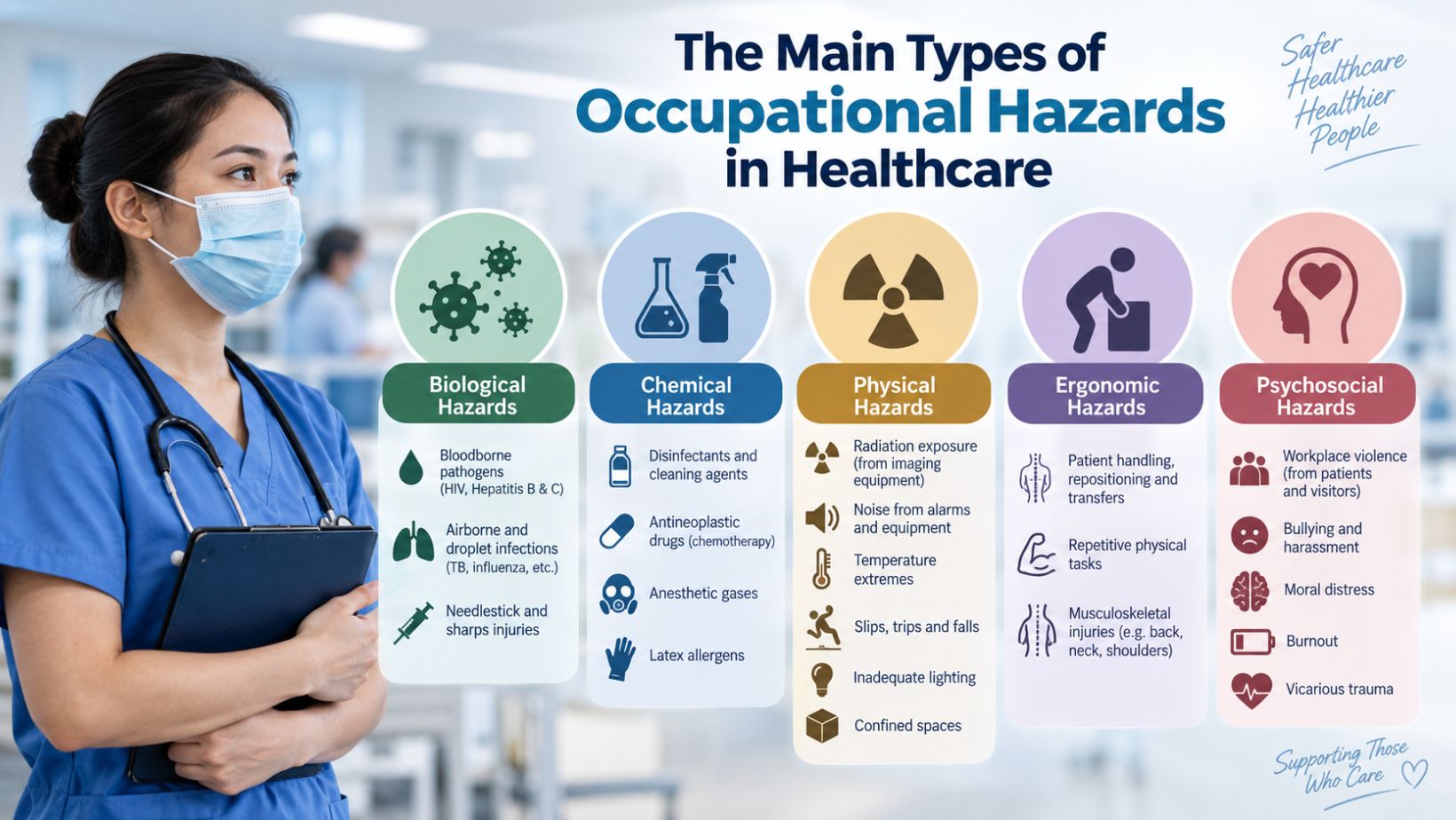
Let us start with a clear taxonomy, because occupational hazards in healthcare are not a single category. They are a collection of distinct risk domains, each requiring its own assessment strategy, prevention approach, and monitoring system.
Biological hazards represent the category most people associate immediately with healthcare work. These include exposure to bloodborne pathogens such as HIV, hepatitis B, and hepatitis C through needlestick injuries or contact with contaminated biological material. They also include airborne and droplet transmitted infections, a category that the COVID-19 pandemic brought into sharp public focus but that has always included tuberculosis, influenza, and a range of other pathogens to which healthcare workers are routinely exposed. According to the Canadian Centre for Occupational Health and Safety, needlestick and sharps injuries remain among the most frequently reported occupational hazards in healthcare settings globally, with a significant proportion going unreported due to time pressure and underestimation of risk.
Chemical hazards are a less publicly visible but equally significant category of occupational hazards in the health sector. These include exposure to disinfectants and cleaning agents, which can cause dermatitis, respiratory sensitization, and long term pulmonary effects with repeated exposure. Antineoplastic drugs used in chemotherapy pose serious occupational hazards for pharmacy technicians, nurses, and cleaning staff who handle or are exposed to residue on surfaces and equipment. Anesthetic gases in operating room environments and latex allergens in clinical spaces are additional chemical exposures that require systematic assessment and control.
Physical hazards encompass radiation exposure from diagnostic imaging equipment, noise from alarms and equipment in intensive care and emergency settings, and the physical demands of working in environments where temperature extremes, confined spaces, or inadequate lighting increase the risk of incident or injury. Slips, trips, and falls in clinical environments are among the most consistently reported physical occupational hazards across hospital settings and contribute significantly to worker injury rates.
Ergonomic hazards are particularly significant in healthcare because so much of clinical work involves patient handling, repositioning, and transferring individuals who cannot bear their own weight. Musculoskeletal injuries resulting from lifting, pulling, and repetitive physical tasks are among the most prevalent work related injuries in nursing specifically, and they represent a major driver of short and long term disability claims in healthcare organizations.
Psychosocial hazards, which include workplace violence, bullying, moral distress, burnout, and vicarious trauma, are now widely recognized as legitimate occupational hazards with measurable physical and psychological health consequences. Healthcare workers experience rates of workplace violence, including verbal and physical aggression from patients and visitors, that are significantly higher than in most other sectors. The psychological weight of high-stakes clinical decision making, grief associated with patient death, and the cumulative moral injury of working in resource-constrained systems add further psychosocial risk that compounds over time.
Why Occupational Hazards in Healthcare Are Underreported
Here is a reality that anyone who has worked in a clinical environment will recognize immediately: the occupational hazards that healthcare workers face are substantially underreported relative to their true incidence, and this underreporting has serious consequences for both individual workers and the organizations responsible for their safety.
Underreporting of occupational hazards in healthcare happens for several interconnected reasons. Time pressure is a primary factor. In a busy clinical environment, stopping to complete an incident report after a needlestick or a patient aggression event competes directly with the next task waiting. Many workers make a rapid calculation that the time cost of reporting outweighs the perceived benefit, particularly when they believe the incident was minor or that reporting will not lead to any meaningful change.
Normalization of risk is another powerful driver. When occupational hazards are common enough that they begin to feel routine, individual workers and even organizational cultures can drift toward treating them as expected features of the work rather than preventable events that demand a response. A unit where aggressive patient behavior happens regularly may develop a culture where staff absorb those incidents rather than escalating them, not because the behavior is acceptable but because reporting feels futile.
Fear of professional judgment is a third factor, particularly relevant to psychosocial occupational hazards such as burnout, moral distress, and mental health impacts. Healthcare workers who acknowledge they are struggling psychologically face real and perceived risks to their professional reputation, their licensure, and their relationships with colleagues in a culture that still, in many settings, values stoicism over transparency about distress.
Addressing underreporting requires organizational commitment to making the reporting process simple, removing the perception that reporting creates professional risk, and demonstrating through action that reported hazards lead to genuine investigation and improvement rather than documentation alone.
How Organizations Can Address Occupational Hazards in the Health Sector
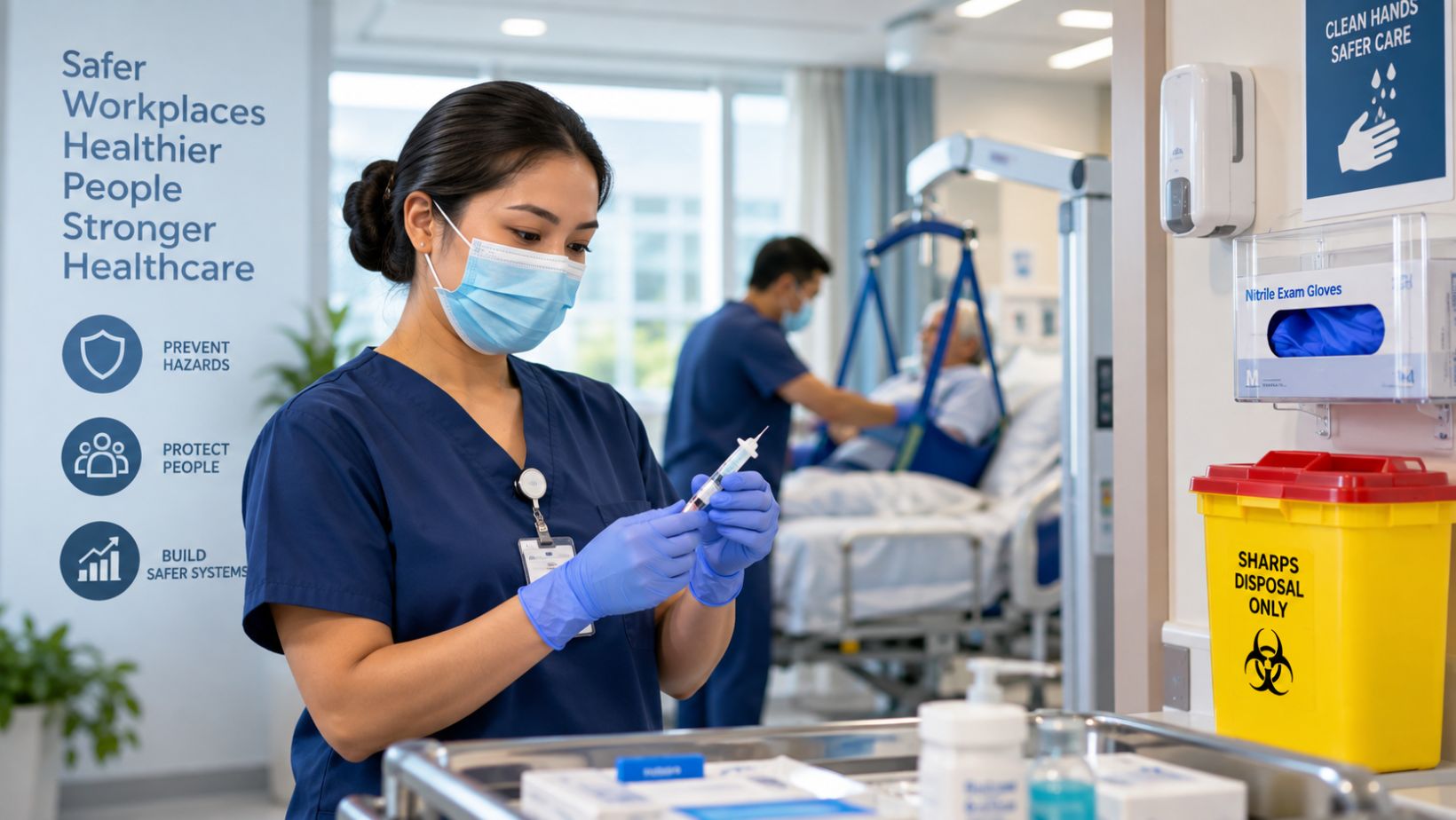
Understanding occupational hazards is the necessary first step, but the organizational response is where the real work happens. Here is what evidence-based occupational health practice looks like when it is actually implemented rather than described in a policy document.
The hierarchy of controls is the foundational framework for managing occupational hazards in any sector, and it applies directly and powerfully in healthcare. Elimination of the hazard is the most effective control and is not always possible in clinical settings, but it is achievable in more situations than organizations typically pursue. Substituting a less hazardous disinfectant formulation, redesigning patient transfer protocols to remove manual lifting entirely, or equipping a unit with retractable needle devices rather than conventional sharps are all elimination and substitution strategies that reduce occupational hazards at the source rather than relying on individual worker behavior to manage residual risk.
Engineering controls, including sharps disposal containers at the point of care, ventilation systems designed to manage airborne contaminants, patient lift equipment in units where transfers are frequent, and physical barriers in triage areas where violence risk is elevated, address occupational hazards through the physical environment rather than through training and behavior change alone.
Administrative controls, which include scheduling practices that prevent chronic fatigue, clear protocols for responding to patient aggression, and supervisory structures that ensure adequate staffing ratios, reduce the exposure of individual workers to occupational hazards through how work is organized and managed. Training and personal protective equipment complete the hierarchy, providing necessary layers of protection while recognizing that they are the least reliable controls when used as the primary or sole response to significant hazards.
The psychological health framework that MDconsultants has written about in their guide on Wellbeing or Burnout: The 13 Factors Shaping Psychological Health at Work is directly relevant here, as many of the 13 factors of psychological health and safety map directly onto the psychosocial occupational hazards that healthcare workers face and that organizations are legally and ethically obligated to address.
The Role of a Medical Consultant in Occupational Health Program Design
Healthcare organizations developing or strengthening their occupational health and safety programs benefit significantly from working with a medical consultant who understands the clinical environment, the specific occupational hazards that different roles face, and the regulatory framework that governs employer obligations in each province. A medical consultant in this space can advise on hazard identification, risk assessment methodology, incident investigation, and the design of return to work programs for workers recovering from work related injuries or illness.
Healthcare Consulting and Occupational Safety Strategy
Healthcare consulting support for occupational health has grown as health organizations recognize that reactive approaches to occupational hazards are more costly than prevention, both financially and in terms of workforce morale and retention. A healthcare consultant with occupational health expertise can help organizations build proactive monitoring systems, conduct organizational risk assessments, and design safety culture initiatives that shift how frontline workers and managers relate to hazard identification and reporting.
For authoritative, freely accessible guidance on the full range of occupational hazards in healthcare settings, including resources specific to Canadian regulatory frameworks and provincial occupational health legislation, the Canadian Centre for Occupational Health and Safety is the definitive national reference and a practical starting point for any organization building or reviewing its occupational health program.
Medical Consultant Networks and Occupational Health Expertise
A medical consultant network that includes physicians with backgrounds in occupational medicine, emergency medicine, and organizational health can provide healthcare organizations with the clinical expertise needed to assess complex hazard scenarios, design intervention programs that are credible to frontline clinical staff, and support the cultural change that genuine improvement in occupational hazard management requires.
Final Thoughts
Occupational hazards in the health sector are not an unavoidable consequence of caring for sick people. They are identifiable, measurable, and in most cases preventable with the right organizational commitment, assessment tools, and control strategies. The healthcare workers who show up every day to deliver care deserve workplaces that take their safety as seriously as the safety of the patients they are there to serve.
Whether your organization is conducting its first formal occupational hazard assessment or is looking to strengthen a program that already exists, the evidence is clear: organizations that invest seriously in addressing occupational hazards retain their workforce longer, experience fewer disability claims, and deliver better patient outcomes than those that treat occupational safety as a compliance obligation rather than a genuine leadership priority.
If you are looking to connect with experienced medical consultants or explore physician-led consulting support for occupational health and workplace safety programs, MDconsultants offers a trusted network of medical professionals ready to help.

