
The five key components of the patient care process are assessment, diagnosis or clinical analysis, planning, implementation, and evaluation with follow up. Together they form a repeating cycle: gather information about the patient, interpret it, build a plan, carry the plan out, then check whether it worked and adjust. Different professions label the steps differently, but the logic is the same, and it helps teams deliver care that is consistent, safe and centred on the patient.
If you have searched questions like “What are the steps of the patient care process?” or “What is the nursing process?”, this guide explains each component and how healthcare organizations can apply them.
What Is the Patient Care Process?

The patient care process is a structured way of delivering care so that every patient receives the same careful sequence of thinking and action, no matter who is on shift. Two widely taught versions show how closely the frameworks align.
In nursing, the process is known by the acronym ADPIE: assessment, diagnosis, planning, implementation and evaluation. It is described as continuous and cyclical, so it does not simply end after evaluation. In pharmacy, the Joint Commission of Pharmacy Practitioners published the Pharmacists’ Patient Care Process in 2014 and updated it in 2025. It has five steps: collect, assess, plan, implement, and follow up by monitoring and evaluating. The updated version applies across all practice settings and modes of delivery, including telehealth.
The common thread is a patient centered, evidence informed approach carried out with the wider care team.
Component 1: Assessment and Information Collection
Everything starts with accurate information. Assessment means gathering subjective information, such as symptoms, history, preferences and goals, along with objective information, such as examination findings, test results and vital signs. Nursing education describes assessment as the foundation of the entire process, because the later steps cannot be effective without accurate and complete data.
Good assessment also looks beyond the diagnosis. The pharmacy framework, for example, includes lifestyle habits, beliefs, functional goals and socioeconomic factors that affect access to medications and other care.
What good looks like: a complete history, clear communication with the patient and caregiver, and information drawn from more than one source, such as the patient, observations and records.
Component 2: Diagnosis and Clinical Analysis
The second component turns raw information into a clinical judgment. In nursing this is the nursing diagnosis, which identifies real or potential health problems based on the assessment. In pharmacy and other professions, this step is often called assessment or analysis, where the clinician interprets the data, identifies problems and prioritizes them in the context of the patient’s overall health goals.
This is where clinical reasoning matters most. Problems are named clearly, ranked by urgency and linked to evidence so the plan targets what truly needs attention.
What good looks like: clearly stated problems, a sensible priority order and reasoning that another clinician can follow.
Component 3: Care Planning
Planning translates the diagnosis into specific, actionable goals and interventions. Good goals are realistic, measurable and tied to a time frame. The pharmacy framework describes an individualized plan that is evidence based and cost effective, developed together with other health professionals and the patient or caregiver.
Planning is not done in isolation. Patients are more likely to follow a plan they helped shape, so shared decisions and clear explanations are part of this step.
What good looks like: documented goals, agreed priorities, defined responsibilities and a plan the patient understands.
Component 4: Implementation
Implementation is when the plan is put into action. This includes giving treatment, performing procedures, educating the patient, coordinating referrals and communicating with the rest of the team. The pharmacy framework stresses that the plan is carried out in collaboration with other professionals and the patient or caregiver, and that continuity of care, including transitions between settings, is supported.
This is also the step where clear documentation and handoffs protect patients. A strong plan can fail if responsibilities are unclear when care moves between units, providers or organizations.
What good looks like: timely delivery of care, clear handoffs and accurate documentation of what was done.
Component 5: Evaluation and Follow Up
The final component checks whether the plan worked. Evaluation compares the patient’s progress with the goals set earlier. If goals are not met, the team looks for barriers, modifies the plan and the cycle begins again. The pharmacy framework describes this step as monitoring and evaluating the effectiveness of the plan and adjusting it with the team and patient as needed.
Follow up is what turns a one time encounter into continuous care. It also creates the data organizations need to measure quality and improve.
What good looks like: scheduled reassessment, clear outcome measures and a documented decision to continue, change or end the plan.
How the Frameworks Compare
| Step | General process | Nursing process (ADPIE) | Pharmacists’ Patient Care Process |
| 1 | Assessment | Assessment | Collect |
| 2 | Diagnosis or analysis | Diagnosis | Assess |
| 3 | Planning | Planning | Plan |
| 4 | Implementation | Implementation | Implement |
| 5 | Evaluation and follow up | Evaluation | Follow up: monitor and evaluate |
The pharmacy model also aligns well with the familiar SOAP note format used in documentation, which shows how the same logic appears across clinical records.
Why the Patient Care Process Matters for Healthcare Organizations
A consistent process reduces variation, supports safer handoffs and makes quality measurable. For leaders, it is also a design tool: when every step has an owner, a standard and a measure, gaps in access, communication and follow up become easier to spot.
MDconsultants help organizations turn these principles into practice. Teams launching new clinics or digital health services can explore healthcare startup consulting. Organizations improving patient flow, referral pathways and care coordination can look at health services delivery. Because consistent care depends on healthy teams, organizational health and wellness support belongs in the same conversation.
Common Gaps and How to Fix Them
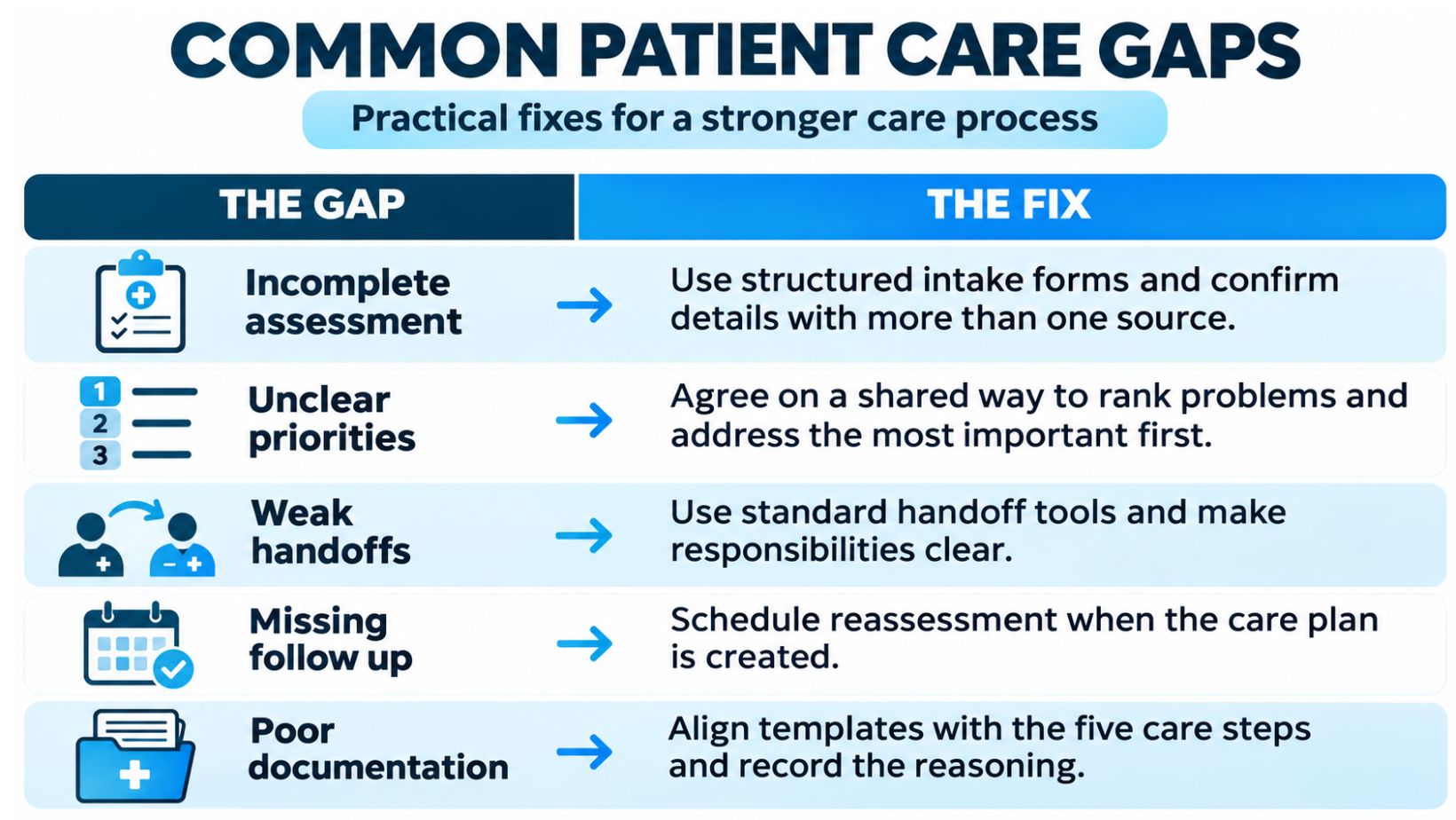
- Incomplete assessment: use structured intake forms and confirm information with more than one source.
- Unclear priorities: agree on a shared way to rank problems so the plan targets the most important issues first.
- Weak handoffs: standardize handoff tools and make responsibilities explicit at every transition.
- Missing follow up: schedule reassessment at the time the plan is created, not afterward.
- Poor documentation: align templates with the five steps so records show the reasoning, not just the result.
Frequently Asked Questions
What are the 5 key components of the patient care process?
Assessment, diagnosis or clinical analysis, planning, implementation, and evaluation with follow up.
What is the difference between the nursing process and the pharmacists’ patient care process?
Both have five steps and follow the same logic. Nursing uses assessment, diagnosis, planning, implementation and evaluation. Pharmacy uses collect, assess, plan, implement and follow up.
Why is the patient care process cyclical?
Because evaluation often shows that goals have changed or were not met, so the team returns to assessment and adjusts the plan.
Who is involved in the patient care process?
The patient and caregivers, along with nurses, physicians, pharmacists, therapists and other team members, depending on the situation.
How can organizations improve their patient care process?
Standardize each step, clarify roles and handoffs, document consistently, measure outcomes and support the wellbeing of the people delivering care.
Conclusion
The patient care process is simple to describe and demanding to deliver well. Assess carefully, analyze clearly, plan together, act with coordination, then evaluate and follow up. Organizations that build this cycle into their workflows protect patients, support staff and create better data for improvement.
If you are a physician or healthcare professional exploring your next opportunity, join MDconsultants. If you lead a clinic, hospital or healthcare venture and want practical support, contact MDconsultants or visit MDconsultants to learn more.

