
Allied healthcare professionals are the large and diverse group of trained health workers who provide diagnostic, therapeutic, technical, and supportive services within the healthcare system alongside physicians and nurses. In Canada, allied healthcare professionals include physiotherapists, occupational therapists, speech language pathologists, medical laboratory technologists, radiological technologists, respiratory therapists, registered dietitians, social workers, pharmacists, and many other regulated and specialized disciplines. Without allied healthcare professionals, the daily functioning of hospitals, clinics, rehabilitation centres, and community health organizations would not be possible, as these practitioners carry out the assessments, treatments, and interventions that physicians order and that patients depend on throughout their care journeys.
If you have spent time in a hospital or a multidisciplinary clinic and noticed how many different professionals were involved in your care beyond the physician who saw you, you were experiencing the work of allied healthcare professionals firsthand. Here are the questions people ask most often on this topic: What is the difference between allied health professionals and nurses? Do allied healthcare professionals need a university degree? Can an allied healthcare professional prescribe medication? What does an occupational therapist do compared to a physiotherapist? Are paramedics considered allied healthcare professionals? This guide answers all of these questions and gives you a clear picture of who these professionals are and why they matter so much to the healthcare system.
Who Are Allied Health Professionals in Canada?
This is the foundational question, and the answer is broader than most people initially expect. Allied healthcare professionals in Canada are regulated health workers who are neither physicians nor nurses but who have completed formal postsecondary or graduate level training in a specific health discipline and who are authorized to practice within a defined scope under provincial or territorial regulatory legislation.
The range of disciplines that fall under the umbrella of allied healthcare professionals is extensive. Physiotherapists assess and treat movement disorders, injuries, and chronic pain through manual therapy, exercise prescription, and patient education. Occupational therapists work with patients whose illness, injury, or disability affects their ability to perform daily activities, helping them develop strategies and adaptations to maintain or regain independence. Speech language pathologists assess and treat communication and swallowing disorders across the lifespan, from pediatric language delays to post-stroke aphasia and dysphagia in older adults.
Medical laboratory technologists perform the diagnostic tests that underpin the vast majority of clinical decisions made in hospitals and clinics, including blood analyses, microbiology cultures, histopathology preparations, and genetic testing. Radiological technologists operate the imaging equipment that produces the X-rays, CT scans, MRIs, and ultrasounds that physicians use to diagnose and monitor conditions. Respiratory therapists manage patients with breathing difficulties, operate ventilators in critical care settings, and conduct pulmonary function testing in outpatient environments.
Registered dietitians provide evidence based nutritional assessment and intervention for patients with conditions ranging from eating disorders and malnutrition to diabetes, kidney disease, and cancer. Social workers in healthcare settings address the social, emotional, and environmental factors that affect patient health and recovery, including access to community resources, family support, mental health, and safe housing.
Each of these professions, and many others, represents a distinct and regulated area of expertise that contributes to outcomes that no single professional discipline could achieve alone. The Canadian Alliance of Physiotherapy Regulators, the Canadian Association of Occupational Therapists, and equivalent national bodies for each discipline set training standards and advocate for the role of allied healthcare professionals within the broader health system.
What Types of Allied Healthcare Professionals Work in Canadian Hospitals
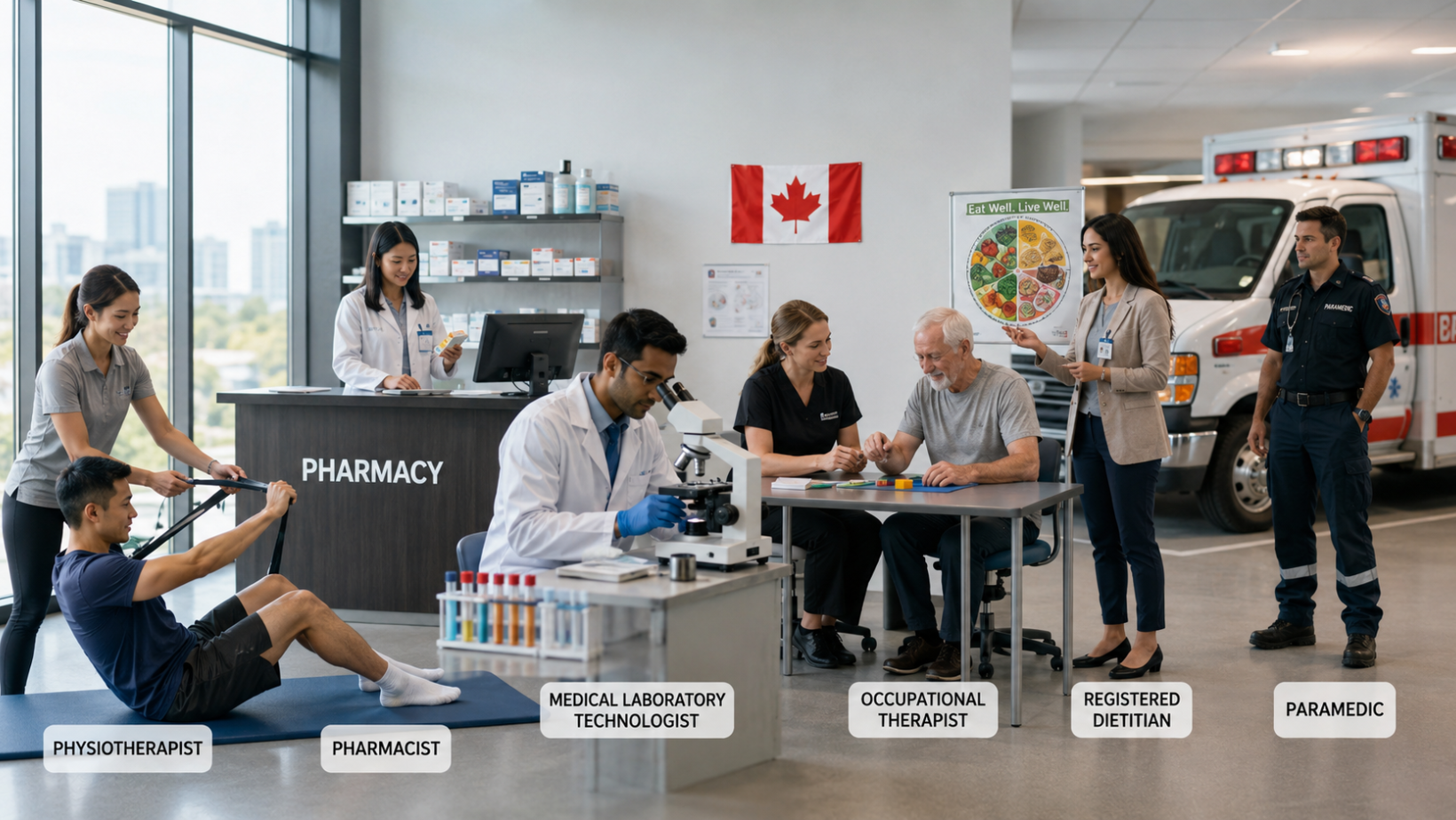
If you have ever been admitted to a hospital, you have likely encountered a wide range of allied healthcare professionals even if you did not know their specific titles. Canadian hospitals employ multidisciplinary teams in which allied healthcare professionals work alongside physicians, nurses, and other clinicians to deliver coordinated, comprehensive care.
In the emergency department, paramedics who have transferred patients from the field are one category of allied healthcare professionals familiar to most Canadians, though their primary training is in prehospital care. Within the emergency department itself, pharmacists who review medication orders for safety, social workers who assess patients presenting with mental health crises, and diagnostic imaging technologists who produce the scans needed for rapid clinical decisions are all allied healthcare professionals working in real time to support patient care.
In inpatient units, physiotherapists visit patients daily to mobilize those recovering from surgery, prevent deconditioning during prolonged admissions, and assess readiness for discharge. Occupational therapists conduct functional assessments that determine whether a patient can safely return home or requires a higher level of care support. Speech language pathologists assess swallowing safety in patients who have had strokes or prolonged intubation to determine when oral feeding can safely resume.
In intensive care units, respiratory therapists are essential members of the care team, managing mechanical ventilators, weaning patients from respiratory support, and performing specialized procedures including bronchoscopies in collaboration with physicians. Medical laboratory technologists process the continuous stream of urgent bloodwork that guides clinical decision making around the clock. Together, these professionals make it possible for a complex hospital environment to function safely and effectively despite the enormous range of patient needs it must simultaneously address.
How Allied Healthcare Professionals Support the Health System

The contribution of allied healthcare professionals to the Canadian healthcare system extends well beyond what happens at individual patient bedsides. At a system level, allied healthcare professionals are among the most important levers available for improving care access, reducing unnecessary hospitalizations, and supporting the kind of coordinated, team based care that produces the best outcomes for patients with complex or chronic conditions.
Expanding the scope of practice available to allied healthcare professionals has been one of the most impactful policy responses to physician shortages and primary care access gaps across Canada. In several provinces, pharmacists have been granted authority to prescribe for certain conditions, administer vaccinations, and adapt prescriptions, functions that previously required a physician encounter. Nurse practitioners, though distinct from the traditional definition of allied health, exemplify how expanded scope can meaningfully improve care access in communities where physician supply is insufficient to meet demand.
The healthcare workforce challenges that Canadian health systems face, as outlined in the MDconsultants piece on Healthcare Workforce Challenges in Canada, make the strategic deployment and empowerment of allied healthcare professionals more important than ever. When physician time is constrained, interdisciplinary teams that leverage the full scope of allied health expertise are the organizations best positioned to serve their communities without proportionally increasing physician workload.
Research on team based care models consistently demonstrates that patients managed by interprofessional teams that include allied healthcare professionals have better chronic disease control, higher rates of preventive care completion, and lower rates of emergency department use and preventable hospitalization than patients whose care is managed by physicians working in isolation. This evidence base is why health system leaders are increasingly designing care around teams rather than around individual practitioners.
The Role of a Medical Consultant in Allied Health Program Development
Organizations seeking to expand or redesign their use of allied healthcare professionals benefit from working with a medical consultant who understands how allied health roles intersect with physician workflows, patient safety standards, and regulatory frameworks. A medical consultant with experience in interdisciplinary care design can help identify where expanding allied health scope adds genuine clinical value and where boundaries need to be clearly defined to protect patient safety.
Healthcare Consulting and Allied Health Integration
Healthcare consulting in the area of allied health program development has grown as hospitals and health networks recognize that optimizing their allied healthcare professionals workforce is one of the most cost effective strategies available for improving both quality and capacity. A healthcare consultant who understands the clinical capabilities of various allied health disciplines can advise on staffing models, scope of practice implementation, credentialing processes, and the design of integrated care pathways that make the best use of every team member’s training.
For authoritative information on the regulation and scope of practice of allied healthcare professionals across Canada, the Canadian Institute for Health Information provides data on allied health workforce composition, distribution, and utilization that is essential context for any workforce planning or program development initiative.
Medical Consultant Networks and Allied Healthcare Professionals Expertise
A medical consultant network that includes physicians experienced in multidisciplinary team leadership and allied health integration can provide healthcare organizations with the clinical perspective needed to design, evaluate, and improve programs that rely on allied healthcare professionals. These networks bring together clinical leaders who have worked alongside allied health teams in real practice environments and who can offer grounded, specific guidance rather than generic organizational advice.
Final Thoughts
Allied healthcare professionals are not a secondary tier of the healthcare system. They are an essential, highly trained, and deeply skilled component of the teams that make modern healthcare possible. From the laboratory technologist whose tests guide your diagnosis to the physiotherapist whose work enables your recovery, allied healthcare professionals touch nearly every patient encounter in the Canadian healthcare system and contribute to outcomes that physicians alone cannot achieve.
Understanding who allied healthcare professionals are, what they do, and why their roles are growing in importance is essential knowledge for anyone seeking care, leading a healthcare organization, or thinking seriously about the future of health system design in Canada.
If you are looking to connect with experienced medical consultants or explore physician led consulting support for allied health program development and health system design, MDconsultants offers a trusted network of medical professionals ready to help.