Operations in healthcare refers to all of the systems, processes, and organizational functions that enable a healthcare organization to deliver care effectively, safely, and sustainably. From scheduling and staffing to supply chain management, patient flow, quality assurance, and financial planning, operations in healthcare encompasses every nonclinical activity that determines whether a hospital, clinic, or health system actually functions the way it is designed to. When operations in healthcare are well designed, patients move through the system efficiently, clinicians have the resources and support they need, and the organization can sustain quality care over time. When operations break down, the effects are felt immediately at the patient level, in longer wait times, delayed procedures, medication errors, and preventable adverse events.
If you are a healthcare leader trying to understand where your organization’s performance gaps are coming from, or a clinician who has noticed that the system around you seems to be working against you rather than with you, this guide is for you. The questions that come up most often in this space include: What is the difference between healthcare operations and healthcare administration? Who is responsible for operations in a hospital? How do you measure whether healthcare operations are working? What tools and frameworks are used to improve healthcare operations? Why do some healthcare organizations perform so much better operationally than others? Let us work through each of these in plain language.
What Operations in Healthcare Actually Covers
Let us start by being specific about scope, because operations in healthcare is a broad concept and the way it is used varies significantly depending on whether you are talking to a hospital CEO, a frontline nurse manager, or a healthcare technology vendor.
At the most foundational level, operations in healthcare covers the logistics of care delivery. This includes workforce scheduling, which ensures that the right number of qualified staff are in the right place at the right time. It includes bed management and patient flow, which determine how quickly patients move through an emergency department, how long they wait for an inpatient bed, and when they can be safely discharged. It includes supply chain and inventory management, which ensures that the medications, devices, and consumables needed for clinical care are available when and where they are needed without being wasted or overstocked.
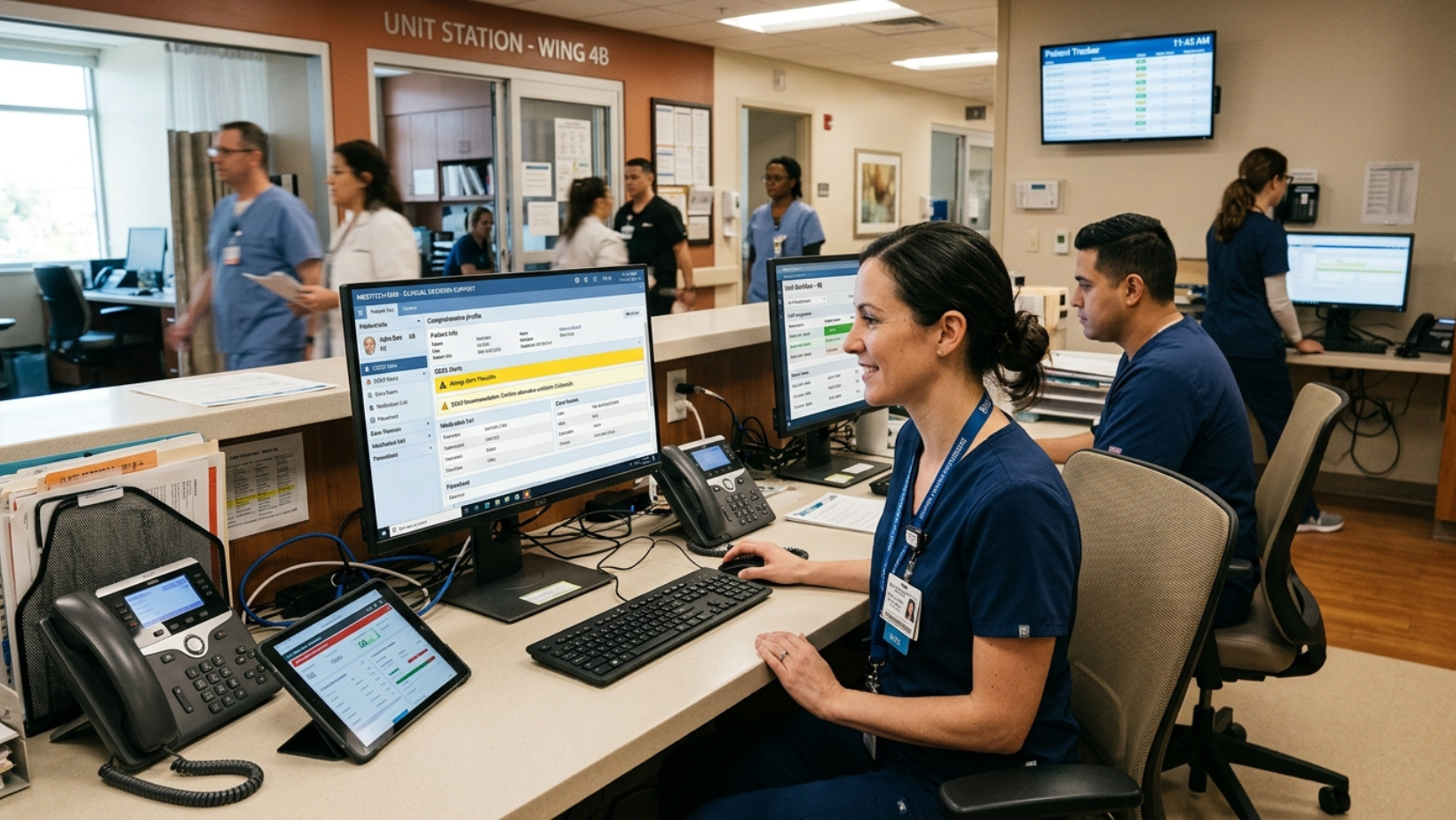
Operations in healthcare also extend into the systems that support clinical decision making without being clinical themselves. Health information systems, electronic medical records, scheduling platforms, and clinical decision support tools are all operational infrastructure. When these systems are well designed and well maintained, they reduce administrative burden on clinicians and improve the speed and accuracy of information flow across care teams. When they are poorly implemented or poorly integrated, they create friction that slows care and increases the risk of error.
Quality and safety programs are another core component of operations in healthcare. These include infection prevention and control protocols, incident reporting systems, accreditation processes, and continuous quality improvement initiatives. Effective quality operations do not simply respond to adverse events after they occur. They build the monitoring, feedback, and learning infrastructure that prevents events from occurring in the first place.
Financial operations, including budgeting, cost accounting, revenue cycle management, and resource allocation, complete the picture. A healthcare organization that delivers excellent clinical care but manages its financial operations poorly will not be able to sustain that care over time, which is why financial sustainability is inseparable from the broader concept of operations in healthcare.
Why Operations in Healthcare Directly Affects Patient Care
Here is the part of the conversation that sometimes gets lost when healthcare operations are discussed primarily in organizational or financial terms. Operations in healthcare is not a back office function that is separate from patient care. It is the infrastructure on which patient care runs, and when it fails, patients pay the price directly.
Think about what happens when patient flow operations break down in a hospital. Emergency department patients wait hours on stretchers in hallways because inpatient beds are not being discharged efficiently. Surgeries are cancelled because operating room scheduling has not accounted for equipment sterilization turnaround times. A patient requiring an urgent specialist consultation waits hours longer than necessary because the referral system relies on fax and phone rather than an integrated communication platform. None of these are clinical failures in the narrow sense. They are all failures of operations in healthcare, and every one of them has a direct and measurable impact on patient outcomes, patient experience, and clinician morale.
Research on hospital operations consistently shows that organizations with strong operational performance, meaning shorter wait times, lower rates of preventable readmission, better medication reconciliation processes, and more efficient discharge planning, also tend to have better clinical outcomes. This is not a coincidence. It reflects the reality that operations in healthcare and clinical quality are deeply interdependent, and that investment in one tends to support the other.
The connection between operations in healthcare and workforce sustainability is equally important and increasingly urgent given the workforce pressures Canadian health systems are facing. Administrative and operational inefficiency is one of the leading drivers of clinician burnout. Physicians and nurses who spend significant portions of their time navigating dysfunctional scheduling systems, chasing down missing supplies, or duplicating documentation because systems do not communicate with one another are losing time and energy that should be directed toward patient care. Improving operations in healthcare is therefore not only an efficiency goal. It is a clinician retention strategy.
Key Frameworks Used to Improve Operations in Healthcare
If you are responsible for improving operations in healthcare in your organization and you are not sure where to start, it helps to understand the frameworks and methodologies that have the strongest track record in healthcare settings.
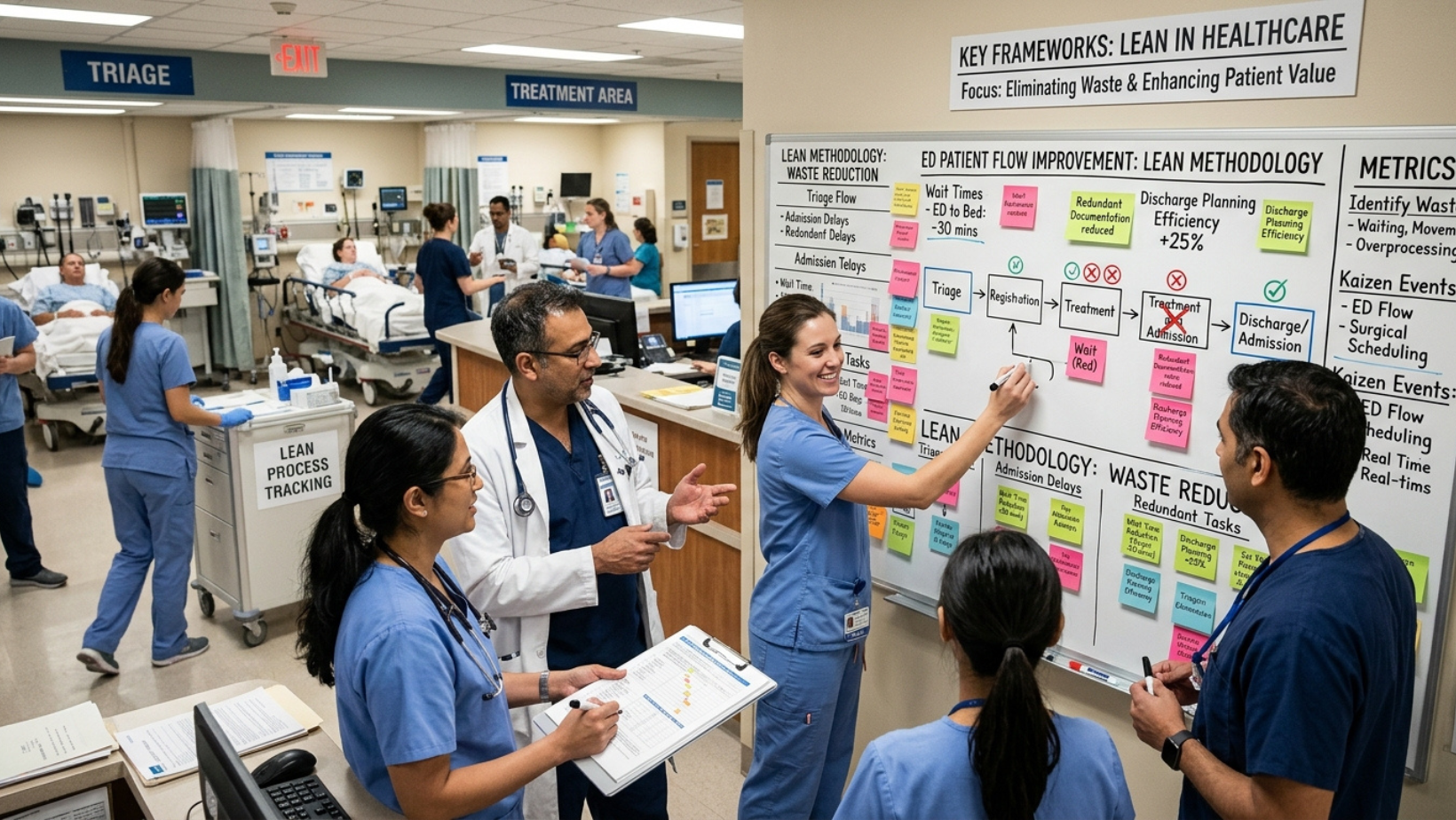
Lean methodology, which originated in manufacturing, has been widely adapted for healthcare and focuses on identifying and eliminating waste in clinical and administrative processes. In a healthcare context, waste includes unnecessary steps in a care pathway, delays caused by handoff failures, redundant documentation, and any process that consumes time or resources without adding value for the patient. Many Canadian hospitals have applied Lean principles to emergency department flow, surgical scheduling, and discharge planning with measurable improvements in wait times and operational efficiency.
The Institute for Healthcare Improvement’s Model for Improvement, based on Plan Do Study Act cycles, provides a structured framework for testing and scaling changes to operations in healthcare in a way that is grounded in real data rather than assumption. This approach is particularly useful in healthcare settings where the complexity of clinical environments makes large scale system redesign risky without iterative testing first.
Value based care frameworks, which connect operational performance to patient outcome measurement, are increasingly shaping how Canadian health systems think about operations in healthcare. The movement toward measuring and funding outcomes rather than volumes is changing the metrics against which operational performance is evaluated, which in turn changes the priorities that operational leaders pursue. MDconsultants has written about this shift in their article on Value Based Care in Canada, which is worth reading alongside this guide for a fuller picture of how funding and accountability models are reshaping healthcare operations.
How Healthcare Organizations Improve Operations in Healthcare
Improving operations in healthcare requires a combination of leadership commitment, data infrastructure, frontline engagement, and sustained attention to implementation over time. Organizations that approach operational improvement as a one time project rather than an ongoing discipline consistently produce short-lived results that do not sustain beyond the initial intervention period.
Leadership commitment means that operational improvement is not delegated entirely to middle management or to a quality improvement department working in isolation. It requires executive sponsorship, clear accountability for performance metrics, and the organizational authority to redesign processes that cross departmental boundaries, which is where most operational failures actually occur.
Data infrastructure means that the organization has access to timely, accurate, and actionable information about how its operations are performing. Wait time data, bed occupancy rates, staff to patient ratios, medication error rates, readmission rates, and patient satisfaction scores are all inputs to operational decision making, and organizations that cannot access this data in real time are perpetually reacting to problems rather than preventing them.
Frontline engagement means that the people who do the work are central to the process of redesigning it. Nurses who manage patient flow on a medical unit, pharmacists who reconcile medications at discharge, and environmental services workers who turn over beds between patients all have knowledge of operational failures that is invisible from the executive level and irreplaceable in designing solutions that actually work.
The Role of a Medical Consultant in Healthcare Operations
Healthcare organizations seeking to improve their operations in healthcare benefit significantly from working with a medical consultant who understands both clinical workflows and organizational systems. A medical consultant can bridge the gap between operational redesign proposals and clinical reality, identifying where changes will work, where they will create unintended clinical risk, and how to sequence improvements in a way that maintains patient safety throughout the transition.
Healthcare Consulting and Operational Transformation
Healthcare consulting has become a central resource for health systems undertaking significant operational transformation. A healthcare consultant with experience across multiple health system environments brings tested frameworks, comparative benchmarks, and implementation expertise that most organizations cannot develop internally within a reasonable timeframe. These engagements are most effective when the consulting relationship includes meaningful frontline clinical engagement rather than operating exclusively at the leadership level.
For evidence-based standards and frameworks on healthcare quality and operations improvement, the Institute for Healthcare Improvement provides one of the most comprehensive and internationally respected libraries of operational improvement resources available in health systems globally.
Medical Consultant Networks and Operational Expertise
A medical consultant network that includes physicians with experience in hospital leadership, quality improvement, and health system operations can provide organizations with the clinical credibility and operational depth needed to drive meaningful and sustainable change. These networks connect healthcare leaders with advisors who have managed similar challenges in real clinical environments, making their guidance both practically grounded and immediately applicable.
Final Thoughts
Operations in healthcare is the infrastructure that makes patient care possible at scale. It is scheduling and staffing, patient flow and bed management, quality and safety systems, supply chain logistics, financial sustainability, and the technology platforms that connect all of these functions together. When operations in healthcare work well, the system feels invisible to patients and clinicians because care simply moves. When they break down, the effects are immediate, visible, and felt most acutely by the people who need care and the people trying to provide it.
If your organization is ready to invest seriously in improving its operations in healthcare, the right expertise and the right framework make the difference between improvement that sticks and effort that does not.
If you are looking to connect with experienced medical consultants or explore physician led consulting support for healthcare operations improvement, MDconsultants offers a trusted network of medical professionals ready to help.